Hardware
Instrumentation, PLC, Signal Conditioning, and Process Equipment
Hardware
The laboratory combines standard PLC training hardware with industrial instrumentation and a small physical process platform.
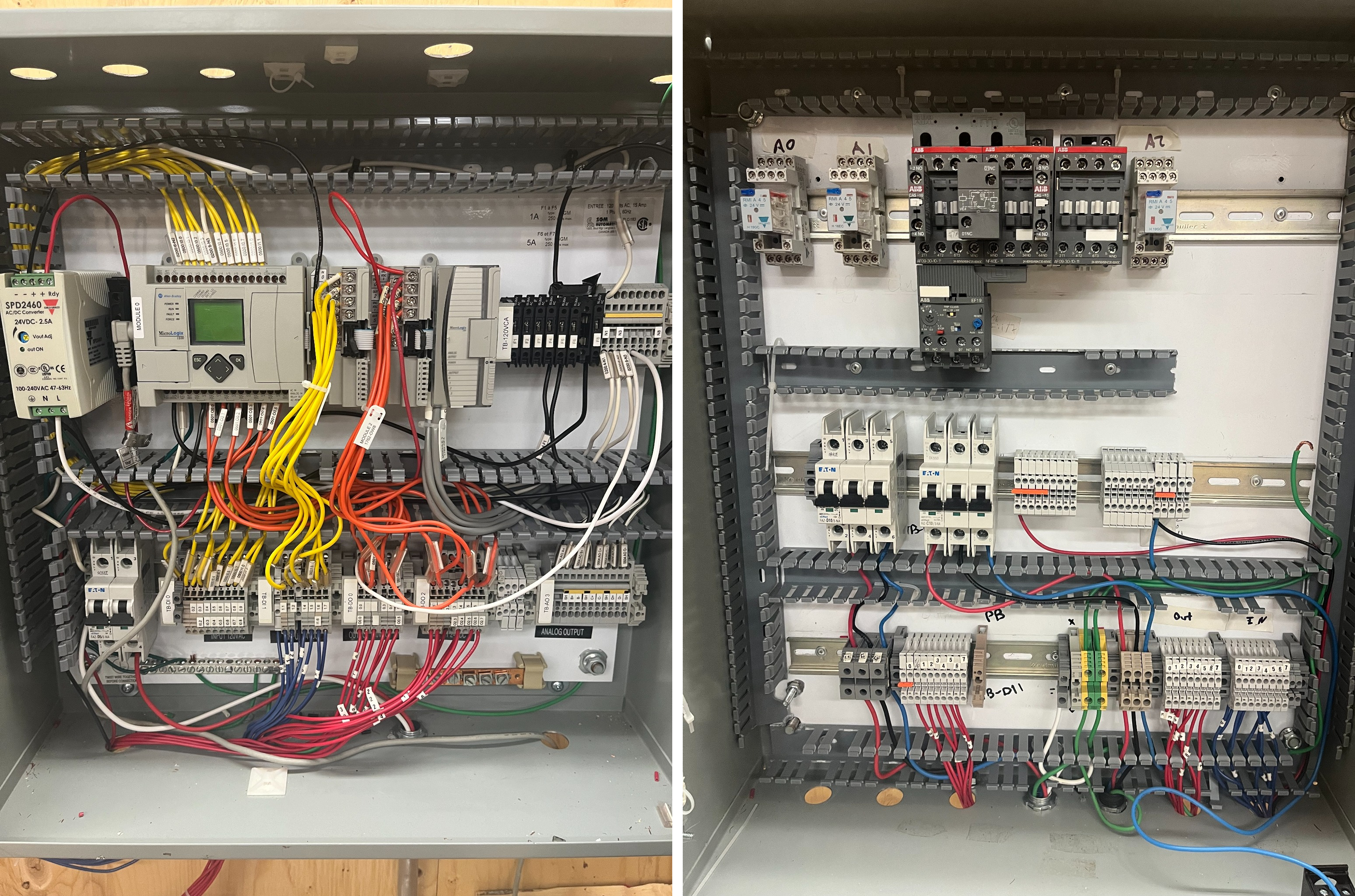
Programmable Controller
The Module 22 environment uses an Allen-Bradley Micro820, with Connected Components Workbench configured for the 2080-LC20-20QWB(R) controller family.
The controller provides the logic platform for analog acquisition, comparison, timing, state decisions, and output control.
Industrial Water-Level Sensor
The primary process sensor uses a 4–20 mA current-loop output. Its role is to provide a continuous measurement of reservoir level and introduce students to industrial analog instrumentation.
Signal-Conditioning Circuit
A dedicated electronic interface adapts the sensor to the voltage-input PLC. The circuit converts the current-derived measurement to a compatible voltage and expands the limited physical measurement span to make better use of the PLC analog-input range.
Passive filtering is incorporated to reduce electrical noise before the signal reaches the PLC analog-to-digital conversion stage.
Reservoir and Pumps
A compact reservoir provides the physical process. DC pumps move water and are controlled through relay interfaces driven by the PLC outputs.
The reduced reservoir size is pedagogically useful because it creates a real design constraint: a limited physical level range produces a limited electrical measurement range, forcing students to consider resolution and signal conditioning.
Relay Interface
Relays isolate the PLC outputs from the pump loads and provide the electromechanical interface between low-power controller outputs and the actuators.
Modular Replication
The system was designed for replication across multiple laboratory kits. The objective is not dependence on a unique component set, but preservation of the functional relationships among:
- industrial analog sensing;
- signal compatibility and conditioning;
- PLC analog acquisition;
- control logic;
- electrical output interfacing;
- and physical actuation.